
SHIPPING DENSITY CALCULATOR
Use this helpful calculator to calculate the density of your shipment.
Density Calculation Example:
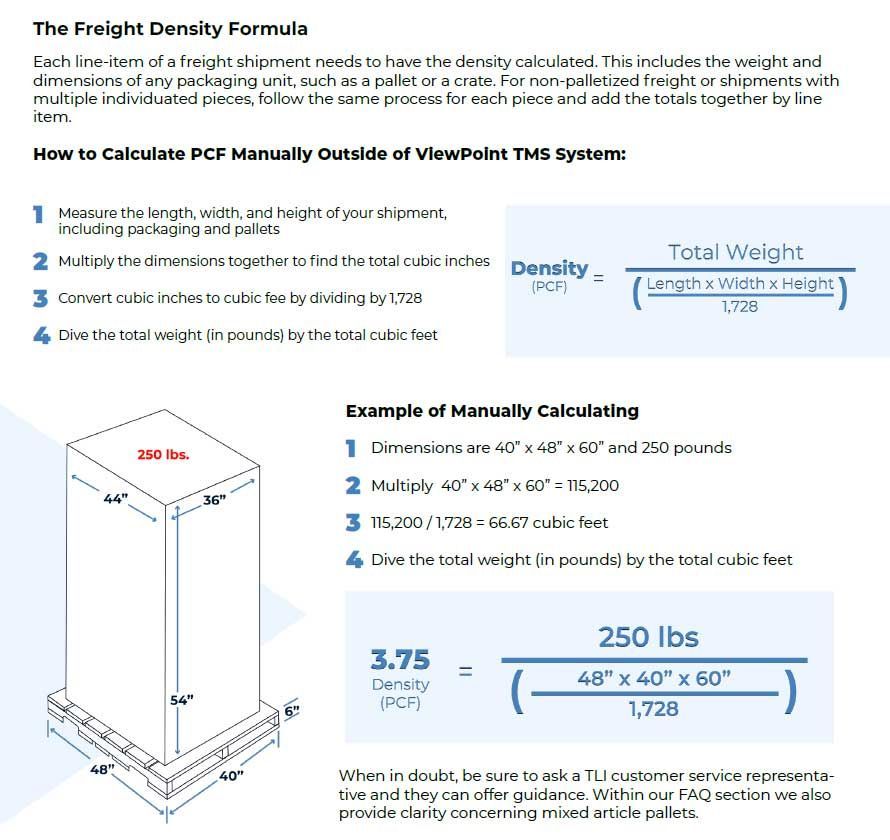
LTL shipments are rated according to NMFC (NMFC is a regsitered trademark of the National Motor Freight Traffic Association) classification guidelines, which primarily consider the product's density, measured in pounds per cubic foot. Knowing the dimensions of your product is crucial for estimating accurate shipping rates. Use these simple freight classification tools to determine the density of your shipment, along with the freight class.
Palletized Dimensions
When a shipment is palletized, the pallet's dimensions determine the cubic size. Even though the original carton dimensions stay the same, the cubic dimensions now also include the pallet.
In the example shown, the density is 3.54 pounds per cubic foot (pcf). You would then rate this against the NMFTA guidelines for your commodity.
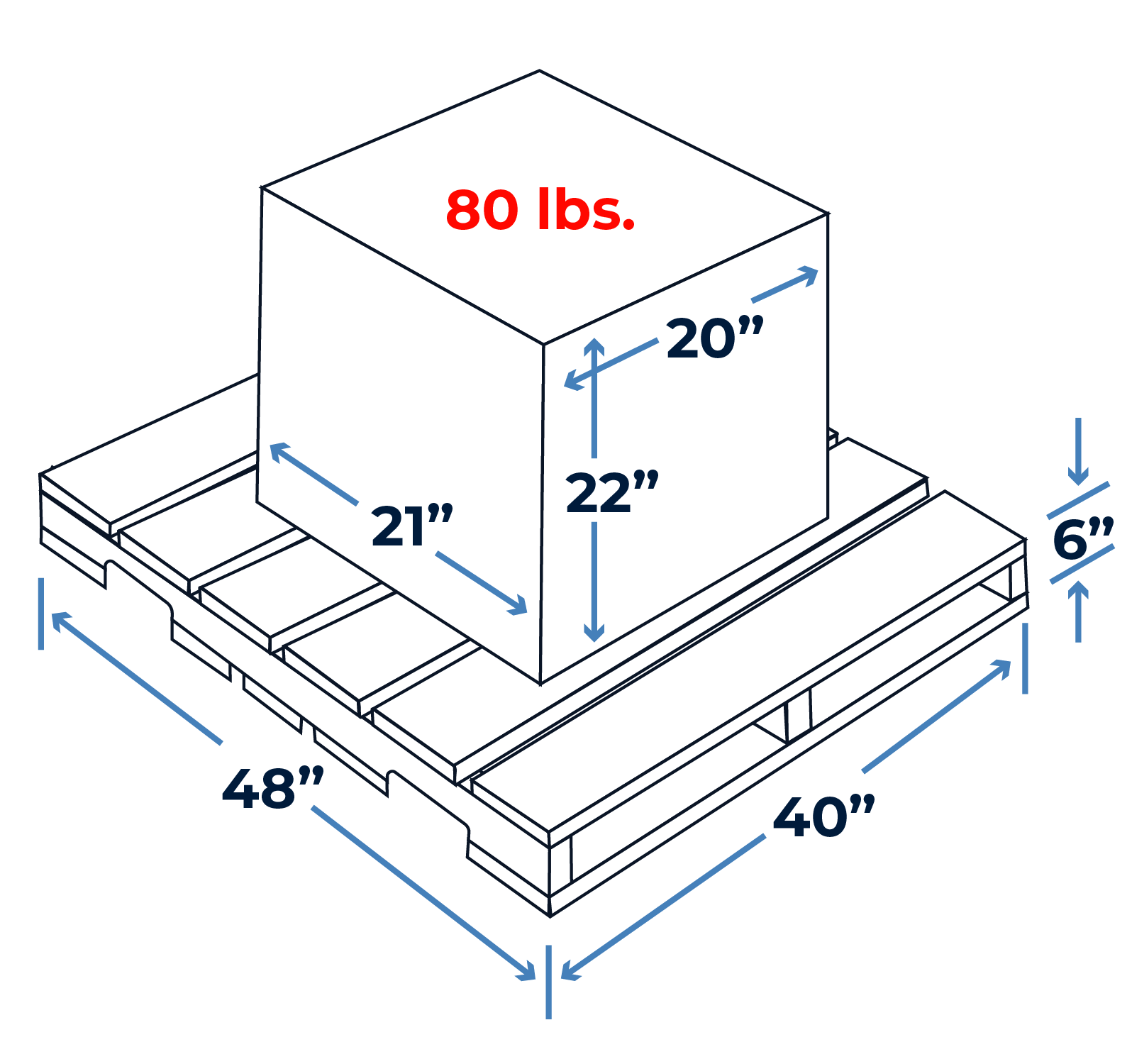
For instance, if you are shipping plastic articles under NMFC number 156600, a density of 3.54 pcf places your shipment in sub 3 of the NMFC. Since sub 3 covers densities "2 but less than 4," your NMFC code will be 156600-3, which corresponds to class 250.
Shipment Example:
- Quantity:
- One pallet
- Dimensions:
- Length: 48"
- Width: 40"
- Height: 28" (22" carton + 6" pallet)
- Weight:
- Total: 110 lbs. (80 lbs. for the carton + 30 lbs. for the pallet)
- Cubic Size:
- Cubic Inches: 53,760 (Length x Width x Height)
- Cubic Feet: 31.1 (Length x Width x Height / 1728)
- Density:
- 3.54
lbs. per cubic foot
(Total weight / Cubic feet)
Shipping Density Calculator:
Please do not use decimals or fractions. Round all numbers up to the next whole number to avoid calculation errors.

Tired of Calculating Freight Class?
Calculating density can be time-consuming.
TLI's Transportation Management System saves time and money by automatically calculating freight class as you enter shipments. Avoid reclassification charges starting today!
Not sure which freight class is correct?
Eliminate the guesswork. ViewPoint TMS automatically filters out invalid density ranges, making your freight class determination, accurate, and stress-free. Select your shipping commodity with confidence!
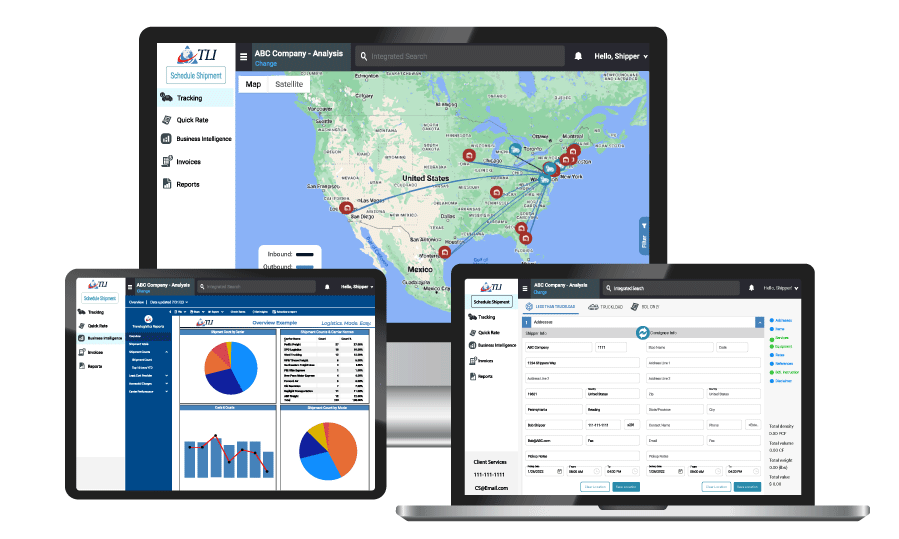
Class Calculator Example
As of July 19, 2025, the NMFC classification has updated the standard full-density scale to be a 13 sub-class system.
TLI is here to assist shippers with shipping any commodity they need to route. We can upload any commodity you route into our transportation management system, which will then help determine and the freight class, and PCF for you. Our system accurately calculates these values using units of volume and considers both density and mass to ensure precise shipping classifications.
By incorporating density mass or volume into the calculations, we provide highly accurate shipment rating data with significant figures, helping you avoid costly billing errors. This ensures that the density and volume of your shipments are accurately reflected, leading to accurate shipping rates and streamlined logistics. TLI's comprehensive approach simplifies the shipping process, giving you confidence that your freight is classified correctly every time.
Density Calculator Freight
Density Calculator
Shippers routing LTL freight often struggle with determining the freight class. To simplify this process, TLI offers the Density Calculator, which works dynamically within our transportation management system.
This resource page provides all the information needed to manually determine the freight class.
Concerned about your inbound raw materials? Many shippers overpay for inbound shipments, but TLI's vendor portal program ensures that even your inbound shipments are autopopulated with the correct freight class.
Using these TMS tools shippers can avoid costly mistakes and potential overcharges. This process not only saves time but also reduces the risk of disputes with carriers, leading to smoother operations, accurate rates and improved efficiency. TLI's vendor portal program offers a substantial advantage for managing inbound shipments. Shippers often overpay due to incorrect freight class determinations on incoming materials.
With the vendor portal, all inbound shipments are automatically assigned the proper freight class, ensuring accurate billing and better control over shipping costs. This comprehensive approach to managing both outbound and inbound logistics allows shippers to optimize their supply chain, reduce freight expenses, and enhance overall profitability.
Acknowledgment of NMFTA's Trademark:
Whenever our educational content refers to the National Motor Freight Classification, we want readers to understand that the term NMFC is a registered trademark of the National Motor Freight Traffic Association (NMFTA). Our goal is to provide helpful industry education while also respecting the intellectual property rights of the NMFTA. Whenever we discuss topics related to freight classification, density, or commodity groupings, we recognize that NMFC identifies the official classification standard maintained and licensed by the NMFTA.
NMFTA is the owner of the National Motor Freight Classification®, more commonly known as the NMFC® (“NMFC”).